Brainwave training, tailored to your nervous system
Addressing what talk therapy often can’t reach — directly, at the level of the nervous system.
People come to neurofeedback through a lot of different doors. A parent watching a child or teen struggle with focus, anxiety, or emotional overwhelm and looking for something beyond medication. An adult who has been on the meds, seen the therapists, tried the protocols — and is still anxious, still scattered, still not able to rest. A student whose mind will not settle long enough to study or sleep. Someone in the middle of emotional overwhelm who genuinely does not know what else to try. Sometimes someone who simply wants their brain to work better than it currently does.
What these arrivals have in common is that the patterns at work are not primarily about willpower or insight. They are physiological — patterns of brain activity affecting arousal, regulation, and recovery that the nervous system has gotten stuck in. Neurofeedback addresses that layer directly, by training the brain directly towards a calmer, more focused and regulated state.
I work predominantly with infra-low frequency training, amplitude-based training, synchrony training, and alpha-theta training — the choice depending on what your nervous system is showing, what your nervous system likes, and what you are hoping to achieve through the training.
What it can help support
Neurofeedback can support a range of experiences where the underlying pattern is one of nervous system dysregulation: persistent anxiety, attention and focus difficulties, sleep that does not restore, the residue of trauma, the exhausted-but-wired state that ordinary rest does not resolve.
Common issues that individuals seek neurofeedback for:
- ADHD
- Anxiety
- Depression
- Autism
- Mood disorders
- Sleep disorders
- Concussion
- Traumatic brain injury
- Chronic headaches
- Learning difficulties
- Short-term memory issues
- Decline in executive function
I have built a short symptom-based assessment that walks through common difficulties neurofeedback has a history of being able to provide help with — and produces a personalized read on how the training might fit for you. A useful first step if you want a clearer sense of where you stand.
For parents
Many parents come to neurofeedback looking for a way to support a child who is struggling with focus, behavior, or emotions — often wanting an option that does not involve medication. Adolescents can also benefit, particularly around attention control, learning difficulties, and emotional regulation.
One thing parents are often relieved to learn: your child doesn’t need to talk about their feelings or explain what is wrong for the training to work. They sit comfortably, watch a screen, and the brain learns from the feedback itself. All that’s required is that they can sit relatively still and watch a screen.
The sensors only read the brain’s electrical activity, the way a thermometer reads temperature — nothing enters the brain. If you are weighing whether this fits your child, the free 15-minute consultation is the right place to ask questions, and the FAQ covers safety in more detail.
How neurofeedback works
Neurofeedback is non-invasive brain training using real-time feedback on brainwave activity. What does this mean?
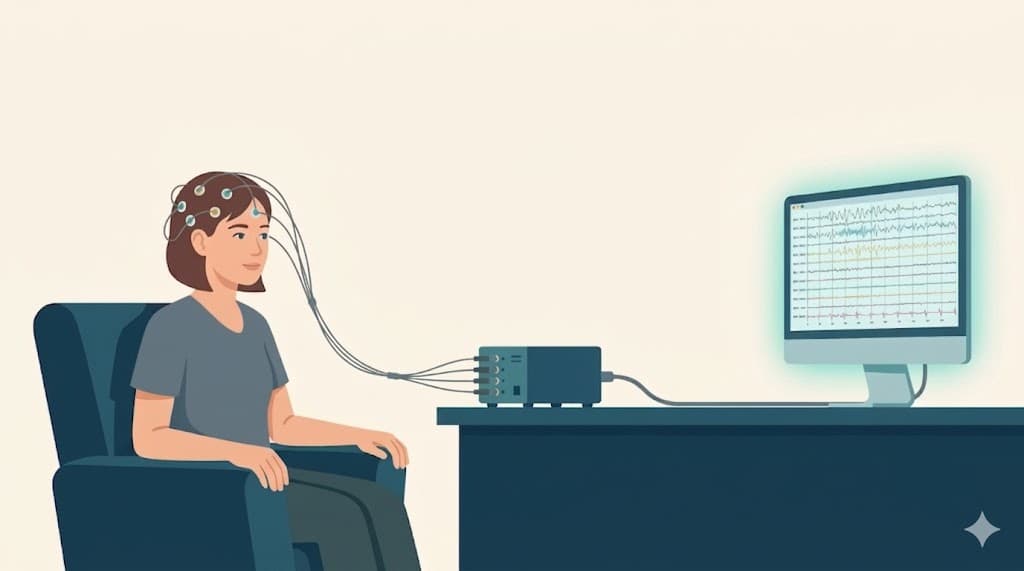
Small sensors placed on the scalp read the electrical activity your brain produces — passively, the way a thermometer reads temperature. While you sit comfortably watching a screen or listening to audio, the software takes in the signal and translates that activity into real-time feedback: a sound or visuals on a screen that shift as your brainwaves shift. The brain takes this information about itself and begins to self-regulate. Over sessions, the changes accumulate — not because anything was done to the brain, but because it was given the conditions to do something itself. It is like providing a mirror to the brain, for the brain to see itself. It will then use this information to make changes accordingly. Individuals often feel this as an experience of calmness, of tiredness, or of deep relaxation.

How is ILF training different from amplitude training?
Amplitude training is protocol-based: it targets specific frequency bands at specific electrode sites, and the feedback rewards the brain as its activity moves toward those targets. Infra-low frequency (ILF) training works below those traditional bands, following the brain’s slowest activity and gently shifting its baseline arousal state. In practice, amplitude training aims at defined targets, while ILF gives the nervous system room to find a more comfortable operating point — which of the two fits best depends on what your nervous system is showing and how it responds.
How the training is tailored
The training is not generic. Before sessions begin, I will work with you to understand the symptoms you are dealing with and the specific improvements you are hoping for — better sleep, less anxiety, sharper focus, emotional steadiness, fewer reactive episodes, the things you would notice in daily life if the training were working.
That picture is what the protocol is built around. My work draws predominantly on the Othmer method of infra-low frequency training and the arousal-regulation model used by Sebern Fisher — two frameworks that treat the nervous system as an interplay of structures and states, rather than as a list of diagnoses.
It is also not diagnosis-driven. Neurofeedback is transdiagnostic — it works on the disorganized brainwave activity and dysregulated states underneath many different diagnoses, rather than on any single label. The aim is to help the brain return to a calm, stable, and focused state it can sustain.
The plan adapts as you go. What you notice between sessions is part of the data. If something is working, you stay with it. If it is not, the approach is adjusted. When the protocol is right, the training tends to feel good — settling, even pleasant. As I like to say, “A regulated brain is a happy brain.”
What a session looks like
Sessions are quiet. Sensors are placed on the scalp; a small amount of paste holds them in place. You sit comfortably and watch a video or listen to audio while the software runs in the background. Sessions typically last one hour, about 15 minutes for a check in and set up, and 45 minutes of training.
There is nothing to perform, no effort to make. The brain learns through the feedback, not through your attention to it or any effortful exertion.
Wondering whether this fits your situation — or your child’s?
Book a free 15-minute consultationWhen you’d rather not talk about it
Some people come to neurofeedback specifically because they do not want to be in therapy. They are tired of telling the story. They have already articulated what is wrong, in detail, more than once, and rehashing it has not produced the change they were looking for. Or talking about the hard parts simply does not feel safe enough yet to be useful.
Neurofeedback does not require you to talk about your history, your feelings, or what is wrong. The brain learns from the feedback, not from disclosure. You can sit through a session quietly and still get the benefit. For some people, that is the entire appeal — improvements that arrive without having to put any of it into words.
Alongside therapy when you want both
Neurofeedback also works well alongside therapy — and for people doing deeper psychological work, the combination tends to be stronger than either piece alone. When the nervous system is more regulated, the conversations that were previously too hard become more possible. Sometimes when dysregulated states are resolved, new patterns must develop to handle old situations in new ways. Many of the people I work with do both, in whatever sequence makes sense for them.
A note from Joshua
An important part of the neurofeedback training process is tempering expectations. This method works differently for different people, as every brain is unique. Some individuals have strongly felt experiences in their body and mind after a single training, others notice subtle shifts throughout the weeks that compound into the change they are seeking, and others are unable to recognize any effect of the training despite the positive changes they see happening in their life. Some individuals need neurofeedback as well as therapy to improve the specific situation they are looking to change, and some individuals with vague goals don’t talk at all and see consistent positive improvements each training session. Each brain is unique, which requires every series of training to be specialized for each individual, adapting and evolving over time to meet the needs of the individual and the brain they have.
What I have found over the years is that the brain is more capable of returning to regulation than people expect — given the right feedback about itself. Most of the people I work with are surprised by how unforced the sessions feel. There is nothing to push, nothing to perform. The harder work is upstream, in listening carefully to what you are actually hoping to change, and matching the training to your particular nervous system. That is the part I find most interesting, and the part most worth doing carefully.
Joshua
Begin with a conversation
If you are considering neurofeedback, a free 15-minute call is a low-stakes place to start. You can ask anything — how the work proceeds, what to expect in the first appointment, whether it fits your situation, or your child’s.
Book a free 15-minute consultationPrefer to reach out directly? jmorrow@renewpsy.com · 517-927-0236